Search
Search all editorial content on the website of the Storting.

At the top of the agenda during the Inter-Parliamentary Union’s (IPU) 152nd Assembly in Istanbul was the election of a new Secretary General. Romania’s Anda Filip received 72 per cent of the votes, and was duly elected.
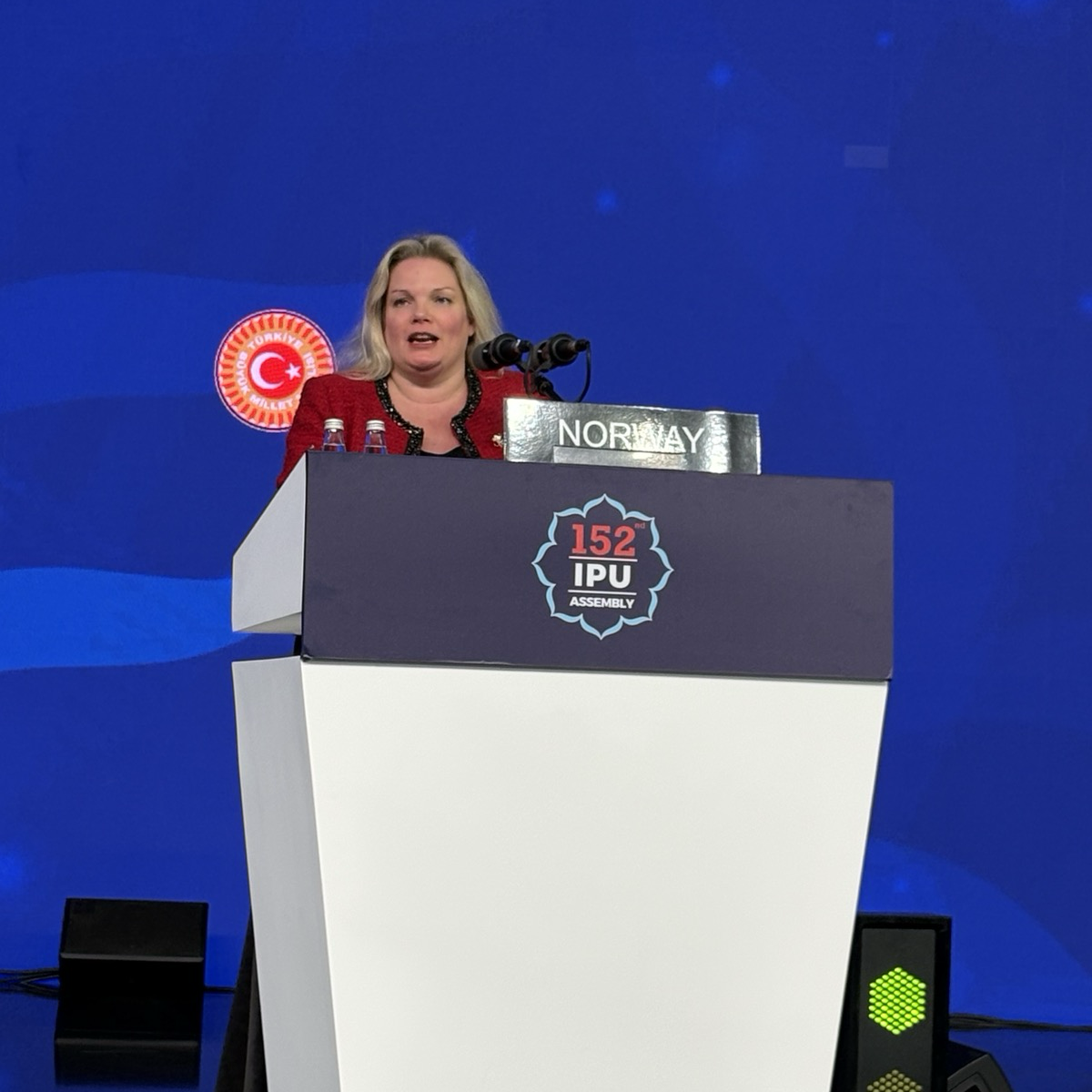
Silje Hjemdal, head of the Storting’s IPU delegation, delivering Norway’s main address during the General Debate. Photo: Storting.
One of the main items of business at the 152nd IPU Assembly in Istanbul was the election of a new General Secretary. The world’s oldest interparliamentary organization has so far had eight Secretaries General since its foundation in 1889. Two of these, the Norwegian Christian Lange and the Swiss Albert Gobat, were awarded the Nobel Peace Prize for their work.
In Istanbul, the choice stood between four women: Cecilia Widegren (Sweden); Anda Filip (Romania); Dionysia-Theodora Avgerinopoulou (Greece); and Fatou Dieng Thiam (Senegal). Anda Filip received 72 per cent of the votes, and was therefore elected by a clear majority. Having worked for the IPU for over 20 years, Ms Filip already knows the organization very well.
Head of delegation Silje Hjemdal (Progress Party) delivered Norway’s main address in the General Debate. She opened by giving her full support to Ukraine. She then emphasized the continuing struggle for human rights and democracy around the world. Ms Hjemdal singled out Iran as a country where the authorities systematically breach their own citizens’ human rights, and drew attention to the thousands who had been killed during the demonstrations earlier this year. While her speech was roundly applauded in the Assembly, Iran’s representative protested loudly when it was his turn to take the floor.
Resolutions were adopted in two of the IPU’s committees. The Standing Committee on Peace and International Security worked through no fewer than 147 draft amendments. Anne Kristine Linnestad (Conservative Party) was Norway’s representative on the committee. Eventually, the committee was able to adopt a resolution on the role of parliaments in establishing robust post‑conflict management mechanisms. Iran, Russia and China expressed their reservations on the resolution. https://www.ipu.org/file/23362/download
The Standing Committee on Sustainable Development passed a resolution on building a fair and sustainable economy through the role of parliaments in combating protectionism, reducing tariffs and preventing corporate tax avoidance. https://www.ipu.org/file/23364/download
During the Assembly, a new report on youth representation in parliaments was presented. The report revealed that progress had stagnated in the past two years. In his speech on the issue, Grunde Almeland (Liberal Party) stressed the key role played by youth parties in Norway. He pointed out that these parties gave young people genuine political influence. Norway has a relatively high proportion of young MPs in the Storting, many of whom have been recruited through the youth party system.
Efforts to cut methane emissions are on the rise, and the IPU arranged a workshop on the topic. Linda M. Merkesdal (Labour Party) took part in the workshop, and shared knowledge and experience from the work done in Norway on this question.
IPU conferences provide a first-class opportunity for bilateral meetings with other member states. This year in Istanbul, the Storting’s delegation, along with their Nordic and Baltic colleagues, met their Ukrainian counterparts. This has become a tradition in recent years, with the meeting format making it easier for Ukraine to meet as many nations as possible in the limited time available. First Deputy Chairman of the Verkhovna Rada, Oleksandr Korniyenko, opened proceedings by thanking each country individually for its support. He went on to describe the situation in Ukraine, saying it was still critical, and that civilian casualties are at their highest level in a long time, a direct result of Russia’s concerted attacks on towns and infrastructure. Mr Korniyenko added that he had little confidence in peace negotiations, and expressed a total lack of trust in Russia. Ukraine’s need for security guarantees was once again underlined.
The Storting’s delegation had a productive meeting with their British colleagues. Of particular interest here were defence cooperation, energy, and Norwegian students’ access to education in the UK. It was also agreed that the two delegations would visit each other in 2027.
The delegation set up a meeting with Istanbul’s Bar Association to find out more about the pressure the Turkish justice system is under, and the process against Istanbul’s imprisoned mayor, Ekrem İmamoğlu. Ms Hjemdal and Mr Almeland also met with an organization called Kaos.gl to discuss the authorities’ increased restrictions on LGBTI+ persons, and access to gender-affirming procedures.
The Storting’s IPU delegation in Istanbul comprised Silje Hjemdal (head of delegation), Grunde Almeland (deputy head of delegation), Anne Kristine Linnestad, Linda Monsen Merkesdal and Hans Andreas Limi. In total, around 1500 delegates were present at the General Assembly. Of these, 720 were parliamentarians from 120 countries.