Search
Search all editorial content on the website of the Storting.

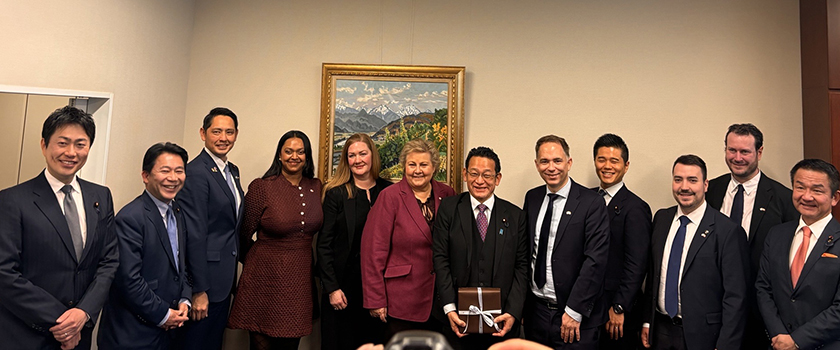
The delegation from the Storting meeting the Foreign Affairs Committee in the National Diet – the Japanese Parliament. Photo: Storting.
War in the Middle East, rising oil prices, and Russia’s war of aggression against Ukraine – now into its fifth year – dominated political discussions during the Asian delegation’s first working visit of the current parliamentary term.
The delegation was away from 3rd to 11th March.
“South Korea and Japan are key partners for Norway in Asia. Both nations are robust democracies, which – like Norway – are committed to maintaining the multilateral world order. It was thus very important for us to speak to our parliamentary colleagues at an early stage of this parliamentary term,” said Tellef Inge Mørland, head of the Storting’s Delegation to the Asia-Europe Parliamentary Partnership (ASEP) and ASEAN’s Inter-Parliamentary Assembly (AIPA), after the visit.
Among those that the delegation met were representatives from both nations’ political leadership, foreign affairs committees, and parliamentary friendship groups with Norway.
A recurring theme throughout the visit was the war that has recently broken out in the Middle East, and concern for the wider effects this will have on the geopolitical situation in general, and sharply rising oil prices in particular. During the discussions, both the Korean and Japanese hosts emphasized that their reliance on oil and gas from the Middle East meant that the conflict had an impact on them as well.
A further concern in both countries was how the war in Ukraine was developing, and what the presence of North Korean soldiers on the Russian front would mean for the threat posed to them by North Korea. It was feared that, in return for its efforts, North Korea would gain access to new military equipment, and build up its knowledge of modern warfare.
This question was brought into greater relief when the delegation visited the demilitarized zone (DMZ) which separates South and North Korea
“Our meetings clearly showed that what may appear as regional conflicts have a direct impact on security politics and the economic outlook in totally different parts of the world. For me, this underlines how vital it is for such like-minded countries as Norway, South Korea and Japan to stand together in these turbulent and rapidly changing times, and to join forces in new strategic partnerships for increased economic security,” Mr Mørland added.
As an important aspect of the strategic cooperation with both nations, the delegation conveyed Norway’s desire to open negotiations on a new trade agreement with Japan, and reiterated the ambition to modernize the trade agreement that Norway and South Korea already have through EFTA.
The delegation also had meetings with researchers and journalists in both countries. The aim here was to gain analytical perspectives on geopolitical developments and the countries’ relations with such important nations as China and the USA. In its efforts to gain insight into Norway’s relationship with South Korea and Japan, the delegation met representatives from Team Norway, the embassies, Innovation Norway and the Norwegian Seafood Council in both countries. In addition, it met representatives from Norwegian business within the maritime, industrial and energy sectors.
All six members of the delegation took part on the trip: Head of delegation Tellef Inge Mørland (Labour Party), deputy head of delegation Erna Solberg (Conservative Party), Helge André Njåstad (Progress Party), Kamzy Gunaratnam (Labour Party), Mats Henriksen (Progress Party), and Anne Lise Gjerstad Fredlund (Socialist Left Party).
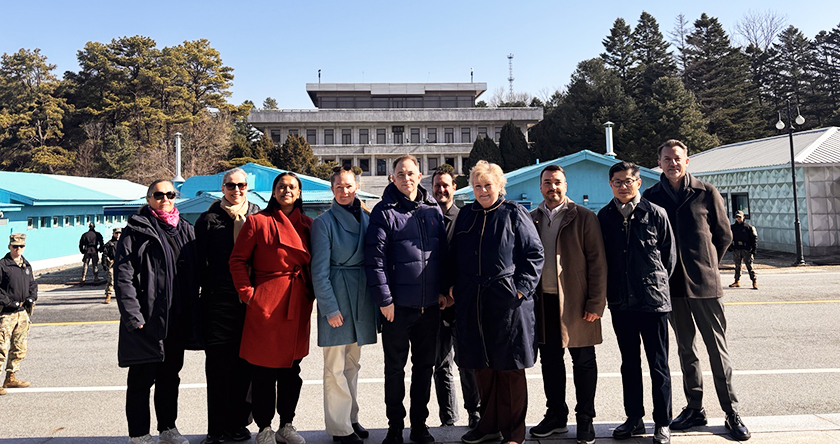
The delegation in the demilitarized zone between South Korea and North Korea. Photo: Storting