Search
Search all editorial content on the website of the Storting.

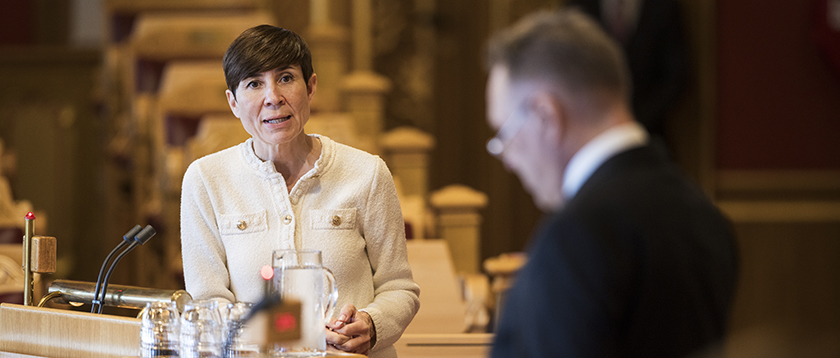
Ine Eriksen Søreide (Conservative Party) puts a question to Minister of Defence Tore O. Sandvik (Labour Party) during the debate on the Long-Term Defence Plan on 12th June 2026. Photo: Storting
The Storting is now in recess. The last sitting of parliament before the summer was held on Friday 19th June, and the Storting will not convene again until the new session is opened in the first week of October.
Here is an overview of some of the most important matters dealt with by the Storting during the 2025-2026 session, the first of four in the current parliamentary term.
The Storting has adopted changes to the National Insurance Act to modernize and broaden Norway’s occupational injury compensation scheme. By removing outdated requirements that an accident must be unexpected or unusually severe, the amendments aim to provide fairer and more realistic protection for employees, address questions of equality, and extend coverage, while ensuring that everyone currently covered remains eligible.
Parliament has dealt with a government bill to amend the Motor Traffic Act. During the committee stage, a Labour Party/Progress Party majority in the Energy and Environment Committee put forward a revised proposal. The new act gives local authorities greater responsibility for managing motorized traffic in outlying areas and waterways in a sustainable way. It aims to do so by balancing environmental protection, outdoor recreation, the needs of local communities, and the rights of Sámi and other traditional cultures.
The Storting has adopted amendments to the Police Act which introduce the routine arming of police officers. The changes bring in a statutory provision stating that police officers will generally carry firearms while on duty.
A temporary amendment to the Alcohol Act has been passed for the duration of the 2026 FIFA World Cup. The change allows municipalities to extend serving hours for beer and wine beyond the normal legal limits, either throughout the municipality or at specific venues. The extended hours apply only to establishments showing live World Cup matches to their customers. The temporary measure will run from 11th June until 19th July 2026, and will be repealed on 20th July 2026.
Parliament has adopted amendments to the Human Rights Act. The recent revision sees the incorporation of the UN Convention on the Rights of Persons with Disabilities (CRPD) into Norwegian law. The Convention will gain legal status in Norway, and will take precedence over any conflicting legislation. The Storting also approved amendments to the Passport Act and the National ID Card Act to ensure that Norwegian law complies with the CRPD’s provisions on citizenship and freedom of movement.
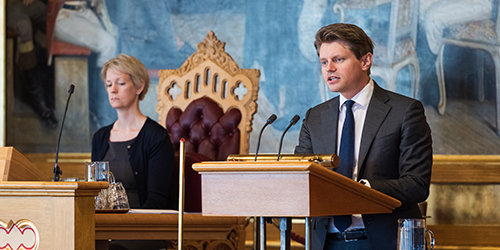
Peter Frølich (Conservative Party) speaking from the rostrum during the debate on the Foreign Minister’s statement on EU and EEA matters, 19th May 2026. Photo: Storting
The Norwegian Parliament unanimously adopted the Defence Pledge (Forsvarsløftet) in June 2024. This decision committed around 1.7 trillion Norwegian kroner (since raised to over NOK 1.8 trillion) to defence over 12 years. The Storting considered a government white paper on the matter in June 2026. The white paper concludes that the Long-Term Defence Plan remains the foundation for strengthening Norway’s defence capability amid a deteriorating security environment. It highlights the need to adapt the plan to a changing security scenario, new NATO capability targets, rising costs, and rapid technological developments, including artificial intelligence and autonomous systems.
The Storting debated a white paper on criminal sentencing, and adopted a number of petition resolutions calling for changes in the correctional services. These include evaluating measures to increase the use of restorative justice, particularly in cases involving children below the age of criminal responsibility. The Government was also asked to review the correctional service’s structure and organisation, and to set up decentralized vocational education programmes to improve recruitment and attract staff with a broader range of professional skills.
The Storting dealt with three separate Private Member’s Motions in one committee recommendation, all of which concerned the further electrification of the island of Melkøya in Finnmark, Norway’s northernmost county. Tabled by the Red Party, the motions concerned stopping the electrification of the Melkøya liquefied natural gas (LNG) plant, stopping the electrification of offshore petroleum installations using power from the mainland grid, and reducing CO₂ emissions through offshore wind power or gas-fired power generation with carbon capture and storage (CCS). None of the three motions were adopted.
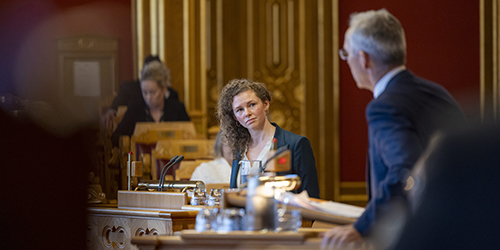
Ingrid Liland (Green Party) debating with Minister of Finance Jens Stoltenberg (Labour Party) after the latter had made the Government’s Budget Speech in the Storting on 15th October 2025. Photo: Storting
A Private Member’s Motion from the Conservative Party on quality assurance of support for floating offshore wind was considered. The Storting has requested an independent review of the government’s floating offshore wind support programme. The review will cover its economic impact, quality assurance, and potential to drive technological development, and must be completed before major commitments are made under the existing support scheme.
The Storting adopted a Private Member’s Motion submitted by the Conservative Party which proposed a temporary suspension of the road tax on fuel from no later than 1st May until 1st September 2026, and a temporary reduction in the CO₂ tax on mineral products for the same period.
A Private Member’s Motion from the Centre Party on vocational rehabilitation was considered. The Storting called on the Government to present an action plan for rehabilitation services in 2027, with the ambition of ensuring equal access to rehabilitation across Norway.
A committee of enquiry has been set up to examine how the Norwegian authorities handled, and should have handled the risks that the Epstein files have disclosed.
Commission of enquiry has its first meeting
On 8th January 2026, Prime Minister Jonas Gahr Støre came to the Storting to set out the Government’s political priorities for the time ahead, while on 3rd March, Minister of Foreign Affairs Espen Barth Eide made a statement in the Chamber on Norway’s international priorities.
The Storting also received a critical report from the National Audit Office on the Police Security Service (PST). After two hearings in the Committee of Scrutiny and Constitutional Affairs, a recommendation concluded that PST has not been adequately equipped to fulfil its role in today’s threat environment. Criticism was also directed at the Ministry of Justice and Public Security for failing to address these shortcomings. The Storting as a whole adopted a resolution in line with the committee’s recommendations, reprimanding former minister Monica Mæland, and passing a vote of censure against her successor Emilie Enger Mehl and the Støre Government.